
Many people make decisions about their spine health based on one simple question: “Does it hurt?”
If the answer is no, they assume everything is fine. If the answer is yes, they look for relief.
But this way of thinking can be misleading and it can lead people to stop care too early, or not seek care at all.
Let’s explore why.
Pain Is a Poor Measure of Spine Health
Pain is important, but it’s actually a late signal, not an early warning system.
Your spine and nervous system may have to lose a large amount of health before pain appears. In fact, many people walk around with reduced spine health for years without any symptoms at all.
Think of it like your teeth:
- You can have early decay without pain
- Pain usually shows up when the problem is more advanced
Your spine works in a very similar way.
Spine Health Exists on a Spectrum
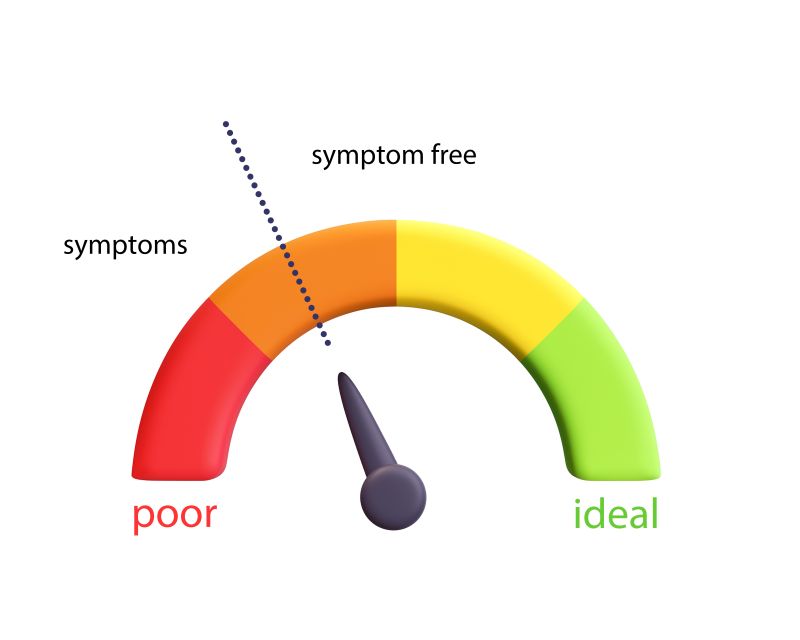
Instead of being “good” or “bad,” your spine health sits on a continuum.
Observe the scale below. By the time you have persisting pain, there is a good chance that part of your spine is in the ‘orange‘ or ‘red‘ zone.
Why Symptoms Can Disappear Before You’re “Healthy”
Let’s say your spine health in one area has dropped to 40%.
At that point, you might start to experience some stiffness or muscle tension.
Time passes, and your spine health drops further to 30%.
You start to feel recurring pain or discomfort.
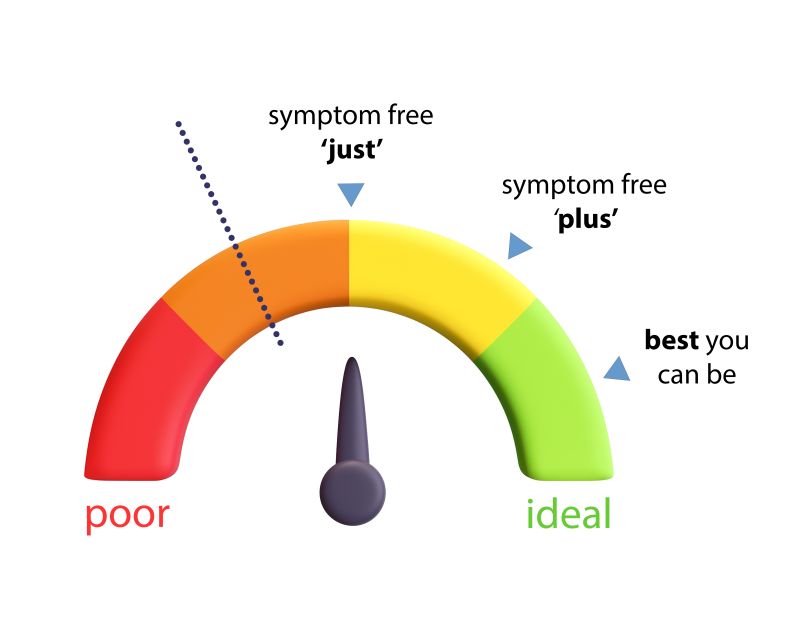
With care, your spine improves to 50% and your symptoms go away.
That’s great progress. But it doesn’t mean your spine is back to full function.
You’re now symptom-free, but not yet at your best.
This is where many people make a critical decision:
- Stop care because the pain is gone
- Or continue improving toward a stronger, more resilient spine
The “20% Improvement” Concept
In many cases, a relatively small improvement in spine function—sometimes around 20–30%—is enough to relieve symptoms.
That’s encouraging. It means your body can respond quickly.
But it also explains why:
- Problems can return
- Minor stresses can trigger flare-ups
- The same issue keeps coming back over time
Because the your spine health in the affected area remains close to its pain / no-pain threshold. *Minimal buffer*
Two Different Health Goals
When it comes to spine care, there are generally two different goals:
1. Symptom Relief Care
- Focus: Reduce pain and discomfort
- Outcome: Feel better
- Timeline: Often short-term
2. Health Restoration / Optimisation
- Focus: Improve function, mobility, and resilience
- Outcome: Stronger, more adaptable spine (distancing yourself further from pain)
- Timeline: Longer-term, more proactive
Neither is “right” or “wrong”—but they are very different choices.
Making an Informed Decision
The most important thing is that you understand your options.
Ask yourself:
- Do I just want to feel better right now?
- Or do I want to improve how well my spine functions long-term?
Because if you believe “pain-free = healthy,” you may stop care before reaching your full potential.
But if you understand that:
- Pain is only part of the picture
- Health exists on a spectrum
- Symptoms often improve before full recovery
…then you can make a more informed decision about what level of health you want to achieve.
A Better Way to Think About Your Spine
Instead of asking:
“Does it hurt?”
Try asking:
“How well is my spine actually functioning?”
That shift in thinking can change:
- When you seek care
- How long you continue care
- The results you achieve over time
Final Thought
Feeling better is a great milestone—but it’s not the finish line.
Understanding the difference between relief and true spine health gives you the power to choose the level of health that’s right for you.
And that’s what informed healthcare decisions are all about.